M365 GCC High vs Google Workspace for Government for CMMC L2: The Decision Most Contractors Get Wrong
The platform you pick for your CUI enclave will define your timeline, your Year 1 budget, and how much of your existing IT environment gets disrupted. Almost no one talks about why — until it's too late to change course.
Every small defense contractor moving toward CMMC Level 2 eventually arrives at the same fork in the road:
"Do we run our CUI enclave on Microsoft 365 GCC High, or on Google Workspace for Government?"
Both are CMMC Level 2 acceptable. Both are FedRAMP authorized at a level the DoD accepts. Both can be configured to satisfy all 110 practices and produce the 180+ artifacts an assessor expects to see.
From 30,000 feet, they look like a coin flip.
From inside the procurement process, they are not even close. The differences in cost, timeline, domain impact, and disruption to your existing M365 environment are large enough — and asymmetric enough — that the wrong choice can cost a small contractor tens of thousands of dollars and push CMMC certification six months past their target date.
This article walks through what actually drives the decision, what most contractors discover too late, and the architectural option that almost nobody talks about until they hire a consultant who has done this before.
Both Platforms Are CMMC L2 Acceptable. They Are Not Interchangeable.
The first thing to understand is that "both platforms can satisfy CMMC L2" is true — and also misleading. It is the kind of true statement that hides where all the real decisions live.
Here is what is actually true:
- Microsoft 365 GCC High is FedRAMP High authorized and was purpose-built for the U.S. Defense Industrial Base. It is the platform a large contractor handling significant volumes of CUI is likely to land on eventually.
- Google Workspace for Government is FedRAMP Moderate authorized — which is acceptable for CMMC L2 — and offers a meaningfully different procurement, provisioning, and operational profile from GCC High.
- Both can host a small-business CUI enclave. Both can produce the artifacts an assessor needs. Both can score well on a self-assessment.
What is also true — and what almost no marketing material from either Microsoft or Google will tell you directly — is that for a small contractor with 3 to 10 CUI users, choosing between these two platforms is not a "platform comparison." It is a comparison of two completely different procurement experiences, two completely different timelines, two completely different impacts on your existing IT environment, and two completely different Year 1 budgets.
The Six Variables That Actually Drive the Decision
If you ask a managed service provider "which platform should I use for my CUI enclave?" and they answer in under five minutes, they are not actually answering your question — they are answering whichever question is easiest for them to sell against.
Six variables genuinely drive this decision. Most contractors discover them in the order shown below — which is unfortunately the worst possible order, because by the time you hit variable #4 you are usually already committed.
Your Year 1 Total Budget
Not the license sticker price. The realistic all-in number that includes licenses, migration labor, configuration work, and reseller markups. The two platforms are not in the same ballpark here. Most contractors estimate this number wildly wrong.
Your Certification Timeline
One platform can be live for CUI work in days. The other has a multi-week minimum provisioning timeline before you can even begin to configure it. If you have a contractual deadline, the timeline question may make the cost question irrelevant.
What FedRAMP Level Your Contracts Specify
Some DoD contracts have begun specifying FedRAMP High, not just Moderate. If yours does, one of these two platforms is eliminated immediately. If yours doesn't, the field is wide open — and the rest of these variables decide.
Your Current Domain Setup
This is the variable that sandbags the most contractors. If company.com is already verified inside a commercial M365 tenant, one of your platform options creates a domain conflict that the other does not. The downstream consequences of that conflict are measured in weeks of work and thousands of dollars.
How Tightly Coupled Your CUI Work Is to L1 Work
If your CUI users mostly do CUI work in isolation, one architecture is dramatically cheaper. If CUI work and general business work flow back and forth constantly, the calculus changes. The line is finer than most people think.
Whether Your Reseller Is Eligible to Sell It
One of these two platforms cannot be purchased directly from the vendor. It must come through a vetted reseller, who must verify your eligibility, who adds margin, and who often charges ongoing management fees. The other has no such constraint.
Notice what is not on this list: which platform has the prettier admin console, which one your IT person already knows, and which one your prime contractor uses. None of those things are decision-grade variables for a small contractor evaluating CMMC L2. The six above are.
Not sure where you stand on these six variables yet? Book a free 30-minute consultation and we will walk you through them against your actual situation.
The Architecture Option Almost Nobody Mentions
When a small contractor asks the question "GCC High or Google?", they are usually being shown a binary choice. Pick one platform. Run everything on it. Live with the consequences.
That binary is incomplete.
There is a third option — well-documented, CMMC-compliant when properly scoped, and increasingly common among small contractors — that very few generalist consultants will lead with, because it requires a deeper understanding of how the two ecosystems coexist than most generalists have.
The Split-Platform Architecture
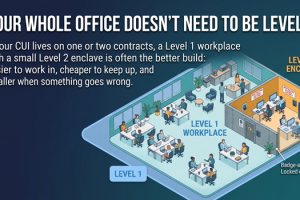
Your existing Microsoft 365 commercial tenant continues to handle all your L1 work — your general business operations, your email, your SharePoint, your Teams — exactly as it does today. No migration. No domain reconfiguration. No disruption.
Alongside it, a dedicated CUI enclave is established on a separate platform — sized for your actual CUI user population, configured to all 110 CMMC L2 practices, and stood up in days rather than weeks.
The two environments coexist. They share your domain. They do not interfere with each other. And the cost profile is fundamentally different from the all-on-one-platform approach.
This architecture is not a workaround or a loophole. It is explicitly addressable in your System Security Plan. Your CUI enclave boundary is clean and documentable. Your assessor sees a coherent, scoped, defensible system.
But there is a catch — and it is the reason this is not the right answer for everyone.
Whether the split architecture is right for you depends on the same six variables above. There is no universal answer — but there is almost always a clear answer for any specific contractor's situation.
The Two Things That Surprise Almost Every Small Contractor
After walking dozens of small contractors through this decision, two facts come up over and over as "I had no idea" moments. Both are worth knowing before you commit to a path.
Surprise #1 — The True Cost Spread Is Enormous
When contractors compare these two platforms, they usually compare license sticker prices. License sticker prices are the smallest part of the actual difference.
The realistic Year 1 total cost — including licenses, reseller markups, migration labor, configuration work, domain reconfiguration where required, and reseller management fees — is not 20% different between these platforms for a small contractor. It is often an order of magnitude different. One path commonly comes in below $5,000 for a 5-CUI-user organization. The other commonly lands somewhere between $18,000 and $50,000 — sometimes more — for the same 5 users in the same Year 1.
Whether that cost spread is justified depends entirely on which contracts you are pursuing and how big your CUI footprint is. For some contractors, the more expensive path is genuinely the right call. For most small contractors with a modest CUI scope, it is not — and they would not have known there was an alternative without specifically asking.
Surprise #2 — Your Domain Is Already a Decision Point You Have Not Made
If you are already on Microsoft 365 commercial, your domain — company.com — is verified inside that tenant. That sounds like an administrative detail. It is not. It is one of the most consequential constraints in this entire decision, and most contractors do not learn about it until they are already weeks into a GCC High procurement and someone says "by the way, we need to talk about your domain."
One of your two platform options will require you to resolve a domain conflict in some way: register a new subdomain, migrate the entire domain to a new tenant, or stand up an entirely separate domain just for CUI users. Each of those resolutions has its own cost, complexity, and user-experience trade-offs.
The other platform option creates no domain conflict at all. Your existing domain stays exactly where it is. CUI users get accounts on the same domain — under a clear naming convention — and the two environments coexist cleanly.
How the Decision Actually Maps Out
Without telling you which platform to pick — because the right answer for your business depends on your specific situation — here is the decision framework that consistently produces clear answers for small contractors:
| If this is true for your business... | ...then your platform decision is heavily influenced by: |
|---|---|
| Your contracts specify FedRAMP High | One platform is eliminated. Skip the cost and timeline comparison — they don't apply to you. The decision is made. |
| You need CMMC L2 self-assessment certified within 90 days | Provisioning timeline becomes the dominant variable. One option can be live in days; the other has a minimum lead time that may make your deadline impossible. |
| Your Year 1 IT budget for CMMC is under $10K | Cost becomes the dominant variable. One path fits this budget comfortably; the other does not, even before you factor in migration labor. |
| Reconfiguring your existing M365 / your company.com domain would cause real business disruption | One option eliminates this risk entirely. The other forces you to choose between three imperfect resolutions. |
| Fewer than 10 users will ever need CUI access, and their work is largely self-contained | The split-platform architecture becomes very attractive. The overhead is small; the savings are large. |
| You are pursuing larger DoD contracts and your CUI footprint is going to grow significantly within 24 months | The long-term consolidation argument matters. Investing now in the platform you will eventually need anyway may be cheaper than migrating later. |
You will notice that most rows in this table point clearly toward one platform or the other — but the table does not name them. That is intentional. The right answer for your business is not a generic answer. It is the answer that emerges when these variables are mapped against your specific contracts, your specific timeline, your specific domain situation, and your specific CUI scope.
That mapping takes about thirty minutes when done with someone who has walked through it before.
Want the platform recommendation for your specific situation? We do this analysis on a free 30-minute consultation — no pitch, just the answer.
Why This Decision Is Worth Taking Seriously
For a contractor who already has the IT capacity, the contract requirements, and the budget to absorb either path, the platform decision is real but not catastrophic. Pick one. Live with it. Move on.
For a small contractor — 5 to 25 employees, modest CUI scope, limited IT staff, finite Year 1 budget, hard deadline from a prime contractor — the platform decision is among the highest-leverage decisions you will make in your entire CMMC journey. The right choice can mean certification in under 90 days, Year 1 spend under $5,000, and zero disruption to the M365 environment your business already runs on. The wrong choice can mean a 6-month delay, a five-figure surprise expense, an unexpected migration project, and a year of explaining to your prime why you are still working on it.
Both of those outcomes start from the same starting point and the same question. The only difference is whether the contractor mapping the decision had seen the decision before.
How Overwatch Tools Helps
Our L2 CUI Enclave Package is purpose-built for the small contractor making this exact decision. We support both platforms — Microsoft 365 GCC High and Google Workspace for Government — and our package includes platform-specific configuration guides, dedicated CUI enclave templates, the SSP framework, the POAM, the Risk Register, the evidence checklist, and a pre-mapped 110-practice → 182-artifact library that your assessor will recognize immediately.
What we do not do is push you onto the platform that is easier for us to support. We do platform selection as part of the kickoff — the right platform for your business, mapped against your real constraints — and only then do we build the enclave around that decision.
- 110 practices → 182 defined artifacts, organized into the 14 CMMC domains, separated by platform
- 12 bi-weekly expert consulting sessions — kickoff, platform decision, build, evidence, dry run, SPRS submission
- Right-sized for small businesses — no Active Directory, no SIEM, no full-time IT staff required
- Platform-specific configuration guides for both Google Workspace for Government and Microsoft 365 GCC High
- Self-assessment focused — built for L2 programs eligible for annual self-assessment, not C3PAO-required programs
- Implementable part-time — every task has a time estimate so you can plan around your actual workload
We provide the templates, the configuration guides, and the consulting. Your team implements with our support. That model is what makes a $50K traditional consulting engagement into a $3,495/year engagement that achieves the same compliance outcome.
Get the Platform Recommendation for Your Business — Free
Bring your situation. We will walk through the six variables, map them against your contracts and your existing IT environment, and give you a clear platform recommendation in under 30 minutes. No pitch. No obligation. No upsell.
If the answer turns out to be "you don't need us," we will tell you that too.
Book Your Free Consultation Explore the L2 Package