CMMC: The L2 Decision Series | Part 3 of 6
CMMC Level 2 Self-Assessment:
Who Qualifies and What's Required?
The difference is worth $47,000. Most small contractors don't know which path applies to them.
By Overwatch Tools | CMMC Compliance Specialists | March 2026
Most small contractors assume CMMC Level 2 automatically means a C3PAO. That assumption is costing them — not just in unnecessary anxiety, but potentially in $47,000 of real money they're pre-committing without realizing there's another option.
Here's the truth: not all CMMC Level 2 programs require a Certified Third-Party Assessment Organization (C3PAO). A significant number of L2 contracts — particularly those involving limited CUI exposure with smaller contractors — are eligible for annual self-assessment, at least during the first two years of the CMMC 2.0 rollout.
Understanding which path applies to your specific program isn't just a compliance question. It's a business planning decision worth tens of thousands of dollars. This post breaks down who qualifies, what the self-assessment window actually means, and what the smart financial play looks like for eligible small businesses.
⚠️ Self-Assessment Programs Only. The L2 CUI Enclave Package and the guidance in this post are scoped for CMMC Level 2 programs eligible for annual self-assessment. Programs where the DoD has required a C3PAO are not in scope. Always review your contract language and consult your contracting officer to determine your program's assessment requirements.
Not sure if your program qualifies for L2 self-assessment?
A free 30-minute eligibility review can clarify your path before you spend a dollar on compliance.
The Misconception That's Costing Contractors
CMMC 2.0 introduced three levels of certification. Level 1 covers Federal Contract Information (FCI) and requires annual self-assessment — no third-party auditor required. Level 3 is reserved for the most sensitive programs and requires government-led assessments. Level 2, which covers Controlled Unclassified Information (CUI), sits in the middle — and it's the most nuanced.
The nuance is this: some Level 2 programs require a C3PAO assessment every three years. Others are permitted to self-assess annually. The determination is made by the DoD at the program level, based on the criticality and sensitivity of the CUI involved.
When contractors hear "Level 2," many assume the expensive path is mandatory. They either delay compliance entirely because the cost seems unreachable, or they start pricing out C3PAO assessments before confirming whether they're actually required. Neither approach is good.
What "Self-Assessment" Means at CMMC Level 2
Self-assessment at Level 2 is not a lighter version of compliance. The practices, artifacts, and documentation requirements are identical regardless of whether a third-party assessor is involved. The difference is who conducts the assessment and validates your posture — not how rigorously you must comply.
A C3PAO is a certified third-party organization that physically reviews your environment, interviews your team, and issues a formal certification. For self-assessment programs, your organization conducts the assessment internally and submits the results to the Supplier Performance Risk System (SPRS) — the DoD's compliance database.
Both paths require:
- Full compliance with all applicable NIST SP 800-171 practices
- A completed System Security Plan (SSP)
- A Plan of Action and Milestones (POAM) for any gaps identified
- An SPRS score submission reflecting your current posture
- Annual review and re-attestation for self-assessment programs
The stakes are real either way. Falsely attesting to compliance in SPRS carries significant legal exposure under the False Claims Act. The self-assessment path is an alternative to a C3PAO — not an easier standard.
Who Qualifies for L2 Self-Assessment?
Eligibility for self-assessment is determined at the program level by the Department of Defense — not by the contractor. The DoD designates which contracts require C3PAO certification based on the sensitivity and criticality of the CUI involved.
Programs Likely Eligible for Self-Assessment
- Contracts involving CUI that is not related to critical defense programs or weapons systems
- Small contractors with limited, well-scoped CUI handling — a defined enclave rather than enterprise-wide CUI exposure
- Programs where the contracting officer has not specified C3PAO certification as a requirement
- Contracts early in the CMMC 2.0 phased rollout where self-assessment is the designated path
Programs Likely Requiring a C3PAO
- Contracts explicitly designating CMMC Level 2 with C3PAO certification language
- Programs involving CUI related to critical defense systems or national security priorities
- Contracts with prime contractors who have specified C3PAO as a supply chain requirement
- Programs the DoD has designated as "prioritized acquisitions" under CMMC 2.0
How Do You Know Which Applies to You?
Review your contract's DFARS clause language — specifically DFARS 252.204-7012, 7019, 7020, and 7021. Your contracting officer can confirm the CMMC level and assessment pathway required for your specific program. If you handle CUI but your contract doesn't specify C3PAO certification, you may be in a self-assessment program — but confirm before proceeding.
The 2-Year Window: What It Is, What It Enables
During the CMMC 2.0 phased implementation, the DoD established a transition period during which self-assessment is the pathway for eligible Level 2 programs — before mandatory C3PAO assessments phase in more broadly. For many contractors, this window represents up to two years of self-assessment eligibility.
What does that mean practically?
- You can demonstrate compliance via self-assessment — completing your SSP, POAM, and SPRS submission without a C3PAO
- You can win and retain CUI contracts during this period with a valid self-assessment on record
- You can use this time to build a compliant posture that would hold up under C3PAO scrutiny — so when the window closes, you're ready
The critical point here is the last one. The smart play isn't just to "get through" the self-assessment window. It's to use the window to build the real posture — so that when C3PAO becomes mandatory for your program (if it does), you're walking in with confidence instead of hoping for the best.
⚠️ What Happens When the Window Closes?
For programs that transition to mandatory C3PAO assessment, there's no grandfather clause on your self-assessment. You'll need a C3PAO to formally certify your environment. If your posture isn't genuinely solid when that happens, you're looking at a failed assessment — and paying full price again.
The self-assessment window is a financial opportunity. It's also a preparation opportunity. Use it both ways.
The C3PAO Cost Reality: $50,000 Per Cycle
Let's talk numbers, because this is where the financial case for using the self-assessment window becomes impossible to ignore.
A C3PAO assessment for a small business typically runs $40,000–$60,000, depending on scope, complexity, and the number of assessor days required. That figure assumes you pass on the first attempt.
What Happens If You Fail?
Fail a C3PAO Assessment = Pay Full Price Again
A failed C3PAO assessment isn't a partial refund situation. Assessors are paid for their time — not for your outcome. If gaps are identified that prevent certification, you remediate and schedule a reassessment. That reassessment costs money. For a small contractor, this scenario represents $80,000–$120,000 in assessment costs alone, not counting remediation effort.
Mock assessments — sometimes marketed as preparation for C3PAOs — typically run $15,000–$25,000 and provide limited remediation detail. They tell you where you stand, but they don't build your artifacts or fix your gaps.
The Budget Gap Nobody's Talking About
Most small defense contractors priced their contracts before CMMC 2.0 requirements were finalized. They didn't build $50,000 C3PAO assessment cycles into their overhead rates. That money has to come from somewhere — contract margins, cash reserves, or worse, from not being able to pursue the next contract at all.
The self-assessment window is a chance to get compliant at a fraction of that cost, document your posture rigorously, and enter any future C3PAO process from a position of genuine readiness rather than scrambling catch-up.
Self-Assessment Window vs. C3PAO Path: Side by Side
| Factor | ✓ Self-Assessment (Window) | ⚠ C3PAO Assessment |
|---|---|---|
| Who conducts | Your organization (internally) | Certified Third-Party Assessor |
| Assessment cost | $0 — you conduct it yourself | ~$40K–$60K per cycle |
| Compliance standard | Full NIST SP 800-171 — no shortcuts | Full NIST SP 800-171 — no shortcuts |
| SPRS submission | Required — annual | Required — every 3 years |
| SSP required | Yes | Yes |
| POAM required | Yes (if gaps exist) | Yes (if gaps exist) |
| Fail = pay again | N/A — internal process | Yes — full assessor cost |
| Availability | Eligible programs only — confirm your contract | Any L2 program |
| Timeline pressure | Window is open now — use it | Scheduling backlog building |
L2 Doesn't Replace L1 — It Builds On It
An important clarification: if your systems handle both FCI (Federal Contract Information) and CUI, you need to address both Level 1 and Level 2 requirements. L2 compliance is not a standalone path that bypasses L1 — it encompasses L1 and extends significantly beyond it.
For contractors new to CMMC who handle CUI, the typical path is:
- Establish CMMC Level 1 compliance for FCI-handling systems (15 practices → 142 artifacts)
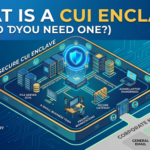
- Build a dedicated CUI enclave for Controlled Unclassified Information handling
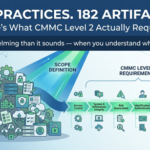
- Address all 110 CMMC Level 2 practices → 182 defined artifacts within the enclave
- Complete SSP, POAM, Risk Register, and SPRS submission
What the L2 CUI Enclave Package Delivers
The L2 CUI Enclave Package is built specifically for small contractors with eligible self-assessment programs — businesses that handle CUI in a limited, defined scope without enterprise IT infrastructure.
L2 CUI Enclave Package — $3,495/year
Self-Assessment Programs Only — optimized for Google Workspace for Government or Microsoft 365 GCC High
- 12 bi-weekly expert consulting sessions (1 hour each)
- 110 CMMC L2 practices → 182 defined artifacts
- System Security Plan (SSP) — pre-filled template
- POAM framework and Risk Register
- SPRS scoring documentation
- Dedicated CUI enclave configuration guides (Google & M365)
- Evidence checklist — packaged and date-stamped
- Time estimates for every task — implementable part-time
- Designed for Windows laptops or Chromebooks (CUI-only devices)
- No Active Directory, no SIEM, no enterprise IT required
- Free 30-minute kickoff consultation
Pair the L2 package with the L1 Turnkey Package and you have a complete compliance posture for both FCI and CUI — with expert consulting included at every step.
✓ The Smart Play: $5,990/Year During the Window
L1 Turnkey Package: $2,495/year (LIMITED TIME: Save $500) — 8 sessions, 15 practices → 142 artifacts
L2 CUI Enclave Package: $3,495/year — 12 sessions, 110 practices → 182 artifacts
Combined: $5,990/year for full L1 + L2 compliance with expert consulting — vs. $50,000+ for a C3PAO assessment you aren't fully prepared for.
Use the self-assessment window to build a posture you can stand behind. When C3PAO eventually becomes mandatory for your program, you'll be ready — and you'll know it.
How Implementation Works
The L2 CUI Enclave Package provides templates, configuration guides, consulting sessions, and documentation frameworks. Your team implements the controls. We provide the roadmap — you drive.
Here's the practical breakdown:
- Owner/Manager: Signs policies, makes approval decisions, conducts quarterly reviews — typically 2–4 hours/month once configured
- IT Point Person: Implements technical controls using our platform-specific configuration guides (Google Workspace for Government or M365 GCC High), handles monthly evidence collection
- CUI Users: Follow documented procedures, complete annual awareness training, report incidents per defined policy
Every task includes a time estimate. The package is designed to be completed part-time — no dedicated compliance officer required.
The Path Through the Self-Assessment Window
-
Confirm Your Program's Assessment PathwayReview contract language (DFARS 252.204-7021 / 7020). Confirm self-assessment eligibility with your contracting officer. Book a free eligibility review with Overwatch Tools.
-
Run the Free CMMC Assessment ToolEvaluate all applicable practices, identify your gaps, and get a prioritized remediation roadmap. No credit card — results in under 30 minutes.
-
Begin L1 Compliance (FCI Systems)The L1 Turnkey Package gets your FCI-handling systems compliant — 15 practices, 142 artifacts, 8 consulting sessions. Most clients complete in 2–4 weeks.
-
Build Your CUI Enclave (L2)Stand up your dedicated CUI environment on Google Workspace for Government or M365 GCC High. Complete 110 practices, 182 artifacts, SSP, POAM, and Risk Register with 12 consulting sessions.
-
Submit to SPRSComplete your self-assessment, calculate your SPRS score, and submit your attestation. You provide the submission — we provide the documentation package.
-
Maintain Annual ComplianceReview and update your posture annually. When C3PAO eventually becomes required for your program, you'll have a documented, tested environment ready for external review.
A Note on SPRS Submission
Self-assessing at Level 2 requires an annual SPRS score submission — the same system used for Level 1. Your organization submits the assessment results and attestation directly. Overwatch Tools provides the scoring framework and documentation package. You make the submission.
Intentional misrepresentation in SPRS can expose your organization to liability under the False Claims Act. The goal of the L2 CUI Enclave Package is to help you achieve genuine compliance — so your attestation accurately reflects your posture.
The Window Is Open. The Question Is Whether You Use It.
A C3PAO will cost ~$50,000 when your program requires one. The self-assessment window is your opportunity to arrive at that assessment fully prepared — having already built, validated, and documented your posture.
Let's confirm your eligibility and map out a path while the window is open. The consultation is free. The information is yours either way.
Schedule Your Free 30-Minute Eligibility Review →Not sure where you stand?
Start with our free CMMC Assessment Tool — no credit card required. Evaluate your current posture across all applicable practices and get a prioritized remediation roadmap in under 30 minutes.
Bottom Line
Not every CMMC Level 2 program requires a C3PAO. Many small contractors with limited CUI exposure qualify for annual self-assessment — and during the current transition period, that window is open right now.
The difference between entering that window with a documented, verified compliance posture vs. scrambling when it closes is the difference between a $5,990 annual investment and a $50,000+ assessment gamble you're not sure you'll pass.
The compliance rigor is the same either way. The preparation, the artifacts, the platform configuration, the SSP, the POAM — it all has to be real. The L2 CUI Enclave Package is built to make that real for small businesses, part-time, without enterprise IT.
The window is open. Use it.
⚠️ Self-Assessment Programs Only. The L2 CUI Enclave Package is scoped for CMMC Level 2 programs eligible for annual self-assessment. Programs required to use a C3PAO are not in scope. Always confirm your program's assessment pathway with your contracting officer before proceeding.
Overwatch Tools | CMMC Compliance Specialists | Chesapeake, Virginia
overwatchtools.com | info@overwatchtools.com
Making CMMC Compliance Achievable for Small Defense Contractors | © 2026