How to Talk to a GCC High or Google Reseller (Without Overpaying)
The procurement conversation no one prepares you for. You can't just buy these platforms on a website — and walking in unprepared is how small contractors end up overpaying or buying the wrong tier entirely.
Part 4 of 6 — The Toolkit Series: Everything You Didn't Know Was Included
You can't just buy Microsoft 365 GCC High with a credit card on a website. You go through an authorized reseller — and if you walk in not knowing what to ask, you'll either overpay or buy the wrong thing entirely.
If you've ever bought a software subscription online, the process is familiar: pick a plan, enter a card, you're live in five minutes. That is not how the government-grade platforms work. Microsoft 365 GCC High and Google Workspace for Government are sold through authorized partners and resellers, with eligibility checks, contract terms, and provisioning timelines that look nothing like a normal SaaS checkout.
That difference catches small contractors off guard. They go in expecting a shopping cart and instead get a sales conversation — one where the reseller knows a great deal more than they do, and where the contractor often can't even describe what they actually need. The result is predictable: they buy what the reseller suggests, which is rarely the leanest, right-sized option.
This article is the prep no one gives you. We'll cover why these platforms work differently, what the tiers mean in plain English, the two ways contractors get this wrong, and — most important — the exact questions to bring so you walk into that conversation knowing precisely what to ask for.
Why These Platforms Work Differently
The government and defense versions of Microsoft 365 and Google Workspace are not self-serve products. You don't sign up directly on a public website and start using them the same afternoon. Instead:
- You buy through authorized resellers or partners. Microsoft 365 GCC High in particular is sold through a limited network of authorized partners, not off Microsoft's consumer-facing store. Google Workspace for Government is similarly provisioned through approved channels rather than a standard online signup.
- There are eligibility requirements. These tiers exist for organizations with a legitimate need — defense contractors, government entities, and businesses handling regulated data. A reseller will typically want to confirm you qualify before provisioning.
- Provisioning takes time. Unlike a commercial subscription that's live in minutes, government tiers can involve validation steps and a multi-day-to-multi-week setup window before you can begin configuring anything.
- The reseller is a salesperson, not a neutral advisor. A good reseller is genuinely helpful. But their job is to sell licenses — and they will sell you what you ask for. If you ask for too much, they'll happily provide it.
The Tiers in Plain English
You don't need a deep technical teardown to have a productive reseller conversation — you need to know roughly where each tier sits and which direction CUI generally points you. (For the full technical comparison of GCC vs GCC High, that's a separate deep-dive blog. Here we're keeping it procurement-focused.)
🟦 Microsoft 365 Tiers
🟩 Google Workspace Tiers
The Two Ways Contractors Get This Wrong
Almost every costly mistake in this conversation falls into one of two buckets. They pull in opposite directions, which is exactly why you need to know your scope before you call — otherwise you're guessing in the dark.
💸 The Overbuying Trap
Resellers sell what you ask for. If you can't describe your scope, the safe move for them is to sell you more — more licenses, higher tiers, add-ons "just in case."
You end up licensing your entire company when only a handful of people actually touch CUI. You pay for capabilities you'll never configure.
Cost: paying year after year for licenses and features you don't need.
⚠️ The Underbuying Trap
The opposite — and more dangerous. You buy a tier that can't lawfully hold CUI, or one that doesn't meet your contract's requirements, because it looked cheaper or simpler.
Then you discover the gap after you've migrated data and built workflows on top of it. Now you're redoing the foundation.
Cost: a wrong-tier purchase means redoing everything downstream — migration, config, and time.
The Questions to Bring to Your Reseller
Print this. Screenshot it. Read it off your phone if you have to. These are the questions that separate a buyer who knows what they want from one who gets sold whatever's convenient.
How to Describe Your CUI Scope (And Why Scoping First Makes This Easy)
Every question in that checklist has the same prerequisite: you have to be able to describe your CUI scope. Not in compliance jargon — in plain, concrete terms a reseller can act on:
- What CUI you actually handle — the type of data, where it comes from, and what your contract requires of it.
- Who touches it — the specific people and roles that need access, versus everyone else in your company who doesn't.
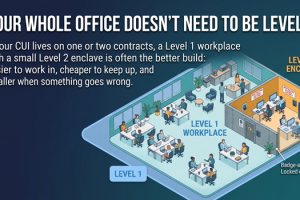
- Where it needs to live — a dedicated enclave for CUI-only work, kept separate from your general business environment.
- How small you can keep it — the tighter the scope, the fewer licenses, the lower the cost, and the simpler everything downstream becomes.
Here's the thing most contractors discover the hard way: they can't answer these questions when they first pick up the phone. They've never formally mapped their scope. So they improvise — and improvising in a sales conversation is exactly how you land in one of the two traps.
Not sure what tier your scope requires? Start with the free assessment to map your scope — then bring it to a free consultation and we'll help you prep the reseller conversation.
Where Overwatch Tools Fits
Let's be clear about what we do and don't do, because it matters here.
We don't resell licenses. We're not a Microsoft or Google partner trying to put a tier in your cart. We have no incentive to push you toward a bigger purchase — because we don't sell the purchase at all.
What we do is help you walk in ready. Our consulting sessions help you define your CUI scope and prep for this exact conversation, so you buy the right tier and the right number of licenses — no more, no less. You make the purchase; we make sure you make it well.
This Is a Prerequisite for the L2 CUI Enclave
This conversation isn't a side task — it's the foundation. Our L2 CUI Enclave Package is built around a dedicated enclave on either Microsoft 365 GCC High or Google Workspace for Government. The configuration guides in that package assume you've landed on the right platform tier.
Get the platform purchase wrong, and everything downstream — the enclave config, the artifacts, the timeline — gets harder. Get it right first, and the rest of the package drops into place. That's why we treat scope and platform selection as step one, before any enclave config work begins.
The package itself maps 110 practices to 182 defined artifacts, includes 12 bi-weekly consulting sessions, and is right-sized for small businesses — no Active Directory, no SIEM, no full-time IT staff required. We provide the templates, configuration guides, and consulting. Your team implements with our support.
Know Exactly Which License to Ask For — Before You Call
The reseller's job is to sell you a license. Your job is to know exactly which one. We help you do that before you ever pick up the phone — map your scope, identify your real CUI-user count, and walk into that conversation knowing precisely what you need.
No pitch. No obligation. Just the prep that saves you from overpaying.
Schedule Your Free 30 Minutes Explore the L2 Package